You've got 22 people, ski bags for everyone, two checked duffels apiece, and a 6:00 AM departure on a January Friday. The rideshare app opens to surge pricing. The first available UberXL shows 38 minutes away.
Someone's bag count just went over the limit for a standard sedan, and the group chat is already spiraling. This is the exact moment a Salt Lake City airport charter bus earns every dollar — one vehicle, one pickup, bags loaded in a single go, group assembled and rolling while everyone else is watching the app crawl toward their car.
Salt Lake City International Airport (SLC) sits six miles west of downtown at 3920 W. Terminal Drive, Salt Lake City, UT 84122, off I-80 Exit 115B — a quick approach in calm conditions, a different story on a storm Friday when the whole Wasatch Front decides to catch the same flight. This guide covers exactly how commercial vehicles operate at the new SLC terminal, where your bus stages while your group collects luggage on Level 2, what it costs to park a fleet of cars at SLC versus booking one bus, and the booking details that trip organizers need before game day. For the broader picture of airport transportation options in Salt Lake City, the Salt Lake City airport transportation page has it all in one place.
Why Rent a Charter Bus or Party Bus for SLC Airport Transfers
SLC is the closest major airport to the largest concentration of destination ski terrain in North America — Park City (37 miles east), Snowbird and Alta (about 30 miles southeast via Little Cottonwood Canyon), Brighton and Solitude just beyond that. That geography makes SLC uniquely brutal for group rideshare on peak travel days. On a powder morning — when a storm dumps overnight and every skier on the Wasatch Front scrambles for first chair — Uber and Lyft surge pricing at SLC routinely runs three to five times the base fare, with wait times of 30 to 60 minutes after peak arrival windows in the 5–8 PM range.
A 20-person ski group flying in on a Friday evening could spend $675–$1,050 on five UberXL rides before a single boot touches snow — and that's the base rate, before the multiplier.
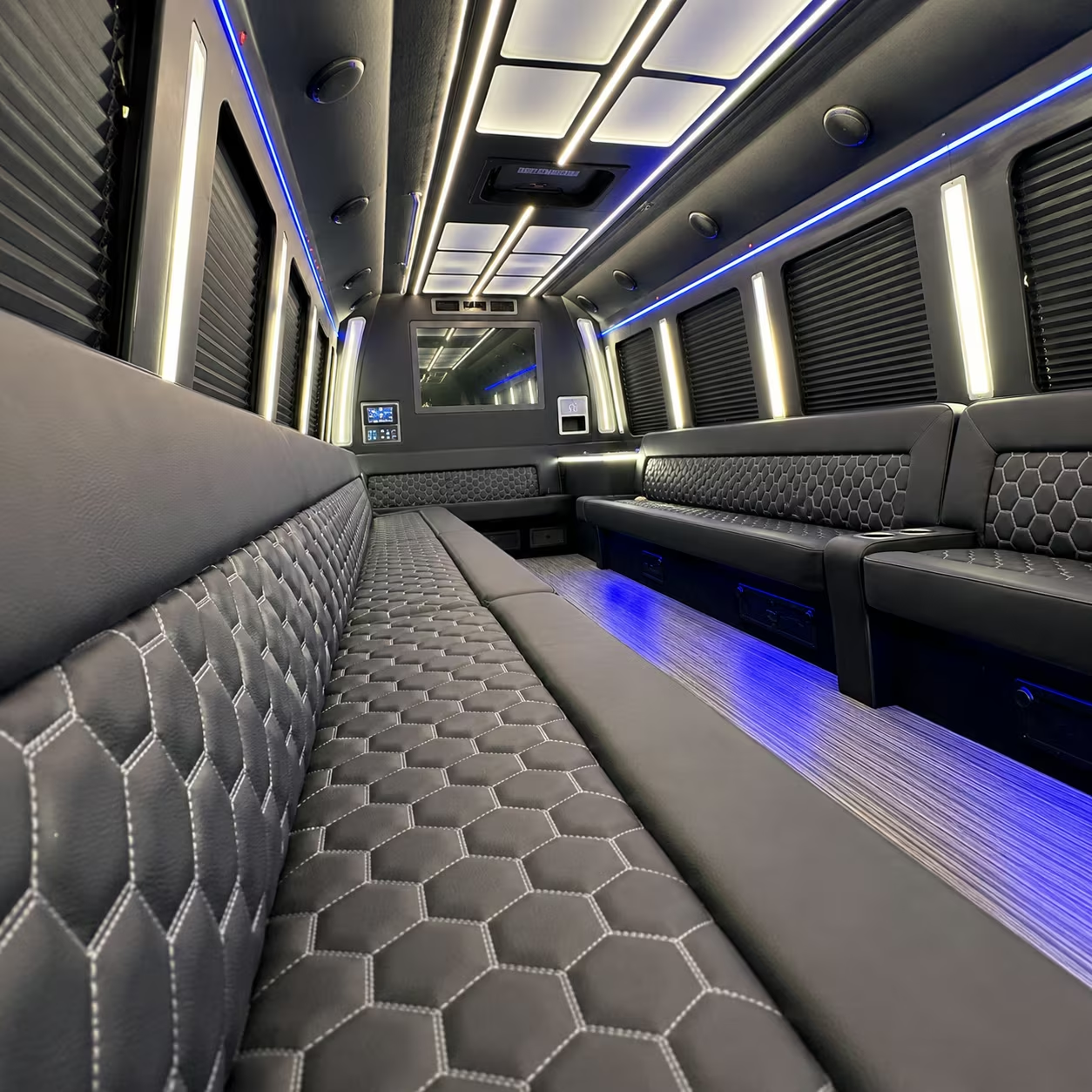
A Salt Lake City charter bus rental changes that math in one move. The full group boards at one place, gear loads into the undercarriage bays, and the bus heads directly to your destination — hotel, condo, base lodge. No surge fare, no 40-minute wait, no splitting the group because the first car filled up before anyone grabbed the ski bags.
And because the bus companies in the network that serve SLC carry the AVI (Automated Vehicle Identification) tag and commercial operator registration the airport's Ground Transportation office requires for all commercial vehicles — no one in your group has to think about compliance rules. That's handled before your flight boards.
Departure runs matter just as much. When your group needs to be at the terminal by 5:15 AM and the usual options are setting four alarms or stacking two rideshare orders and hoping one shows up, a pre-arranged bus pickup from your hotel lobby is the version of airport logistics that actually works. Call 385-230-6303 any time for a free quote, or use the online tool for pricing in under a minute.
Charter Bus & Party Bus Drop-Off at Salt Lake City International Airport
The new SLC terminal — completed in phases between 2020 and 2026 and totaling 908,754 square feet — runs on a split-level roadway that keeps private cars and commercial vehicles completely separated. Knowing which level your bus uses is the difference between a clean drop-off and a group standing on the wrong curb with ski bags stacked around them.
Level 3 (elevated roadway): This is the private passenger car departure lane. Stay right on Terminal Drive approaching the terminal to access the elevated road. If a friend is dropping someone or your group is in a rental car, this is the lane.
Charter buses and commercial shuttles do not use it.
Level 1 (ground level): Commercial vehicles — charter buses, minibuses, hotel shuttles, rideshare pickups — all operate here. A 13-foot height restriction at the terminal front curb is the reason: full-size charter buses cannot use the standard elevated drop-off lane and are directed to the designated Bravo (B) Lane on the ground level. Per the airport's official ground transportation page, hotel shuttles operate between columns 1B and 5B, while charter buses and commercial shuttles drop off between columns 3B and 5B.
Rideshare pickups (Uber, Lyft) also use the B-Lane — look for the curbside TNC signs, which are distinct from the charter bus staging columns.
For arriving groups: after collecting luggage on Level 2, take the escalator or elevator down to Level 1, exit through the ground-level doors, and locate your bus in the B-Lane. Your group coordinator should send the pickup call only once everyone is assembled on Level 1 with bags in hand — not while the last carousel is still spinning. The airport's official pick-up/drop-off page lays out the approach clearly, and it's worth a read before your travel day.
Commercial Vehicle Permits at SLC: What the Network Handles for You
Salt Lake City's Department of Airports requires all commercial ground transportation operators to carry either an AVI tag affixed to the windshield or a Pay-for-Use pass for the specific trip. Per the airport's Ground Transportation FAQ, interstate operators must submit registration paperwork including a copy of their DOT MC Certificate, and vehicles caught operating without payment or proper AVI tags face citations and fines under Salt Lake City ordinance. This compliance layer applies to every commercial vehicle that enters the terminal roadway.
Working with established transportation companies that already serve SLC means the registration and permitting are handled on their end — your group just shows up and loads.
The gather-first protocol at SLC: Designate one coordinator in your group before the flight lands. They collect the final headcount once every bag is off the carousel and the group is together at Level 1. Then — and only then — they call the bus to the B-Lane.
Commercial vehicles are not supposed to idle in the curbside lane for extended periods; the airport's ground transportation office monitors compliance. One call when the group is actually ready beats three premature calls and a bus circling Terminal Drive.
Where Your Bus Waits: The Park & Wait Lot at SLC Airport
Arriving groups almost always take longer at baggage claim than planned — delayed carousels, a bag claimed at a separate counter, international passengers clearing customs at Level 1 while domestic arrivals file through Level 2. The answer at SLC is the free Park & Wait Lot, located west of Terminal Drive just southeast of the terminal. This is where your bus stages while your group descends from Level 2 and assembles at the B-Lane.
The lot displays large electronic flight information signs showing arrival data and "ready for pick up" notifications once the typical luggage claim window has elapsed — so the wait is not blind. On-site amenities include a Chevron gas station, an Extra Mile convenience store, a Burger King, and a Costa Vida, which is useful context if your group arrives in two separate flights 90 minutes apart or if your connection lands during an off-peak boarding window. The airport's pick-up/drop-off page also notes an idle-free policy in the Park & Wait Lot — SLC sits at 4,226 feet and the airport takes air quality seriously, which some vehicle types are more sensitive to than others at altitude.
Your bus stages there, the flight board shows the baggage claim is active, your coordinator sends the call, and the bus moves to the curb.
SLC Airport Terminal Layout: What Your Group Needs to Know
The new terminal replaced a sprawling five-concourse facility with a single 908,754-square-foot building designed around a linear two-concourse layout. For groups coordinating across multiple flights, the layout has a few operational details worth knowing before you land.
Level 1 (ground floor): International arrivals exit through customs here — separate from the domestic baggage claim flow. TRAX Green Line station is also on Level 1 (exit Door 1A, walk east). Commercial vehicle pickup happens at Level 1's B-Lane curbside.
Level 2 (baggage claim): Eight carousels handle arriving flights. The Senator Jake Garn Greeting Room — a waiting area near baggage claim with seating and historical exhibits — is where meeters and greeters wait for domestic arrivals. A pedestrian bridge with moving walkways connects Level 2 to the parking garage and the Gateway Center.
Level 3 (check-in and elevated curbside): Airline check-in counters are on this level, along with the elevated roadway for private passenger car drop-off.
Concourse A handles primarily Delta Air Lines. Concourse B handles Alaska, American, Frontier, JetBlue, Southwest, and United. Two underground tunnels connect them within the secure area — the newer River Tunnel, opened as part of Phase 3 in October 2024, is a 1,175-foot passage that cut typical A-to-B connection times from over 13 minutes to under six.
For groups arriving on split flights — half on Delta into Concourse A, half on Southwest into Concourse B — the River Tunnel is the fastest path to a shared assembly point. Designate Level 1 ground floor at the B-Lane as the meeting spot once everyone clears baggage claim, and call the bus when the headcount is complete.
Getting to SLC Airport: Approach Roads and Timing
The airport sits directly off Interstate 80, reached via Exit 115B northbound onto Terminal Drive. From downtown Salt Lake City — about six miles east — the off-peak run takes under 15 minutes. From the south end of the valley (Sandy, Draper), add I-15 North to the approach; figure 25–35 minutes off-peak.
The canyon runs are the variable. Parley's Canyon on I-80 East (the route to Park City) and Little Cottonwood Canyon (the route to Snowbird and Alta) are steep mountain corridors that go to chain or AWD requirements on storm days and occasionally close entirely for avalanche control — the same powder days that make ski season worth flying in for are the ones that add 30 to 60 minutes to canyon drives.
| From… | Approx. distance | Typical drive time (off-peak) |
|---|---|---|
| Downtown Salt Lake City | ~6 miles | 10–15 minutes |
| Sandy / Draper (I-15 S corridor) | ~20 miles | 20–30 minutes |
| Provo (I-15 S) | ~48 miles | 45–60 minutes |
| Ogden (I-15 N) | ~37 miles | 35–45 minutes |
| Park City (I-80 E, Parley's Canyon) | ~37 miles | 35–45 min dry / 60–90+ in storm |
| Snowbird / Alta (Little Cottonwood Canyon) | ~32 miles | 40–55 min dry / 75–90+ in storm |
On Terminal Drive itself: stay right to reach the elevated Level 3 departure roadway for private cars. Stay left to access the ground-level commercial zone and the Park & Wait Lot. For groups with departing passengers on a charter bus, the bus enters the ground-level commercial lane and pulls to the B-Lane between columns 3B and 5B.
No elevated ramp, no private car curb — straight to the commercial ground-level curb, load in, and the group is through the Level 3 check-in upstairs by the time most rideshare apps are still showing 30-minute ETAs.
Parking at SLC Airport: The Cost That Makes the Bus Easy Math
Salt Lake City International Airport runs a structured parking system with five tiers. Here are the current rates per the official SLC airport parking page:
- Premium Reserved Parking (Garage Level 2, closest to terminal skybridges): $65 per day
- Daily Garage Parking (Garage Levels 2–3): $45 per day
- Hourly Garage Parking (Garage Levels 2–5): $5 per hour, $45 per day maximum
- Lot E: $5 per hour, $25 per day maximum
- Long-Term Economy Parking: $14 per day, complimentary shuttle to terminals included
Run the math for a group ski trip: 10 cars parked in Long-Term Economy for five days at $14/day costs $700 in parking before anyone pays for gas or navigates Parley's Canyon in a snowstorm. A single charter bus carrying 40 people at example rates of $200–$350 per hour handles that same group's airport-to-resort transfer for one flat, predictable amount — no 10-pass parking charge, no 10-tank gas fill-up, and no canyon driving by people who flew in from sea level and have never done it before in snow.
The parking garage itself sits directly south of the terminal, connected to Level 2 via the pedestrian bridge. Garage height clearance is 8 feet 6 inches — standard vehicles clear it easily, but oversized vans or pickup trucks with roof-rack ski carriers should verify before assuming they fit. The economy lot is the cheapest option at $14/day, but it adds a shuttle ride between the lot and the terminal — one more step with luggage at 5:00 AM when your group's flight is already boarding.
One bus, one cost. A 20-person group in five UberXL rides at $135–$210 each comes to $675–$1,050 for one leg — before surge pricing on a peak powder day, which can push those fares to multiples. One Salt Lake City airport minibus rental at the same group size splits one flat rate across 20 people, loads all the gear at once, and does not check the rideshare app for availability before it shows up.
TRAX and Public Transit at SLC Airport
The airport's UTA TRAX Green Line station is at ground level on the east side of the terminal — exit Door 1A and walk east to reach it, per the airport's public transportation page. One-way fare is $2.50; the run to downtown Salt Lake City takes about 26 minutes. TRAX operates from roughly 5:00 AM to midnight, running every 15 minutes during peak hours and every 20–30 minutes off-peak.
Full schedule details are at rideuta.com.
For a solo traveler with a carry-on and a downtown hotel, TRAX at $2.50 is the cleanest option on the board. For a 15-person corporate team with rolling bags and laptop cases, the coordination challenge of loading a light rail car during a packed arrival window starts to outweigh the cost advantage. For a 20-person ski group with equipment bags, ski cases, and boots — the calculation is over before it starts.
A 15–35 passenger minibus loads the full gear complement in one step and does not require anyone to carry a ski bag up an escalator to a platform.
SLC Airport Transportation: Every Option Compared
A Salt Lake City airport charter bus is not the automatic answer for every group. Here is an honest look at what works, and what does not, depending on your group's size and situation:
| Option | Cost shape | Group stays together? | Gear / luggage | Best for |
|---|---|---|---|---|
| Private charter bus or minibus | One flat rate, split across group | Yes — one vehicle, one arrival | Excellent — undercarriage bays handle ski bags and full luggage loads | 15–56 passengers, gear-heavy trips, peak ski dates |
| TRAX Green Line | $2.50/person each way | Only if everyone boards the same train | Poor — no room for ski bags or oversized equipment on a rail car | Solo travelers or small groups, carry-on only, downtown destination |
| Rideshare (Uber / Lyft) | Per car each way, plus surge on peak days | No — multiple cars, staggered arrivals | Varies — SUV required for gear, and still limited | 1–4 people, no equipment, non-peak timing |
| Long-Term Economy Parking ($14/day) | $14/car/day with complimentary shuttle | Yes (per car) | Full trunk, but shuttle adds a step at both ends | Solo traveler or couple, short trip, familiar with the shuttle |
| Taxi (Yellow Cab) | Metered, per car | No — multiple cabs for anything over 4 people | Limited trunk space | 1–4 people, straightforward route, no gear |
The inflection point is somewhere around the size of one rideshare car. Below four people with light luggage and a downtown destination, TRAX or a single rideshare often wins on cost. The moment your group fills two or three cars — especially with ski bags, presentation gear, or checked luggage — the coordination cost and split-arrival problem tips the math toward one bus.
That's the group the rest of this guide is written for.
What Size Bus Does Your Group Need for SLC Airport Runs?
The right vehicle for an SLC airport transfer depends on your headcount, the luggage volume, and the nature of the trip. Here is how the full vehicle lineup maps to common SLC airport scenarios:
| Vehicle | Typical seats | Luggage | Best airport use case |
|---|---|---|---|
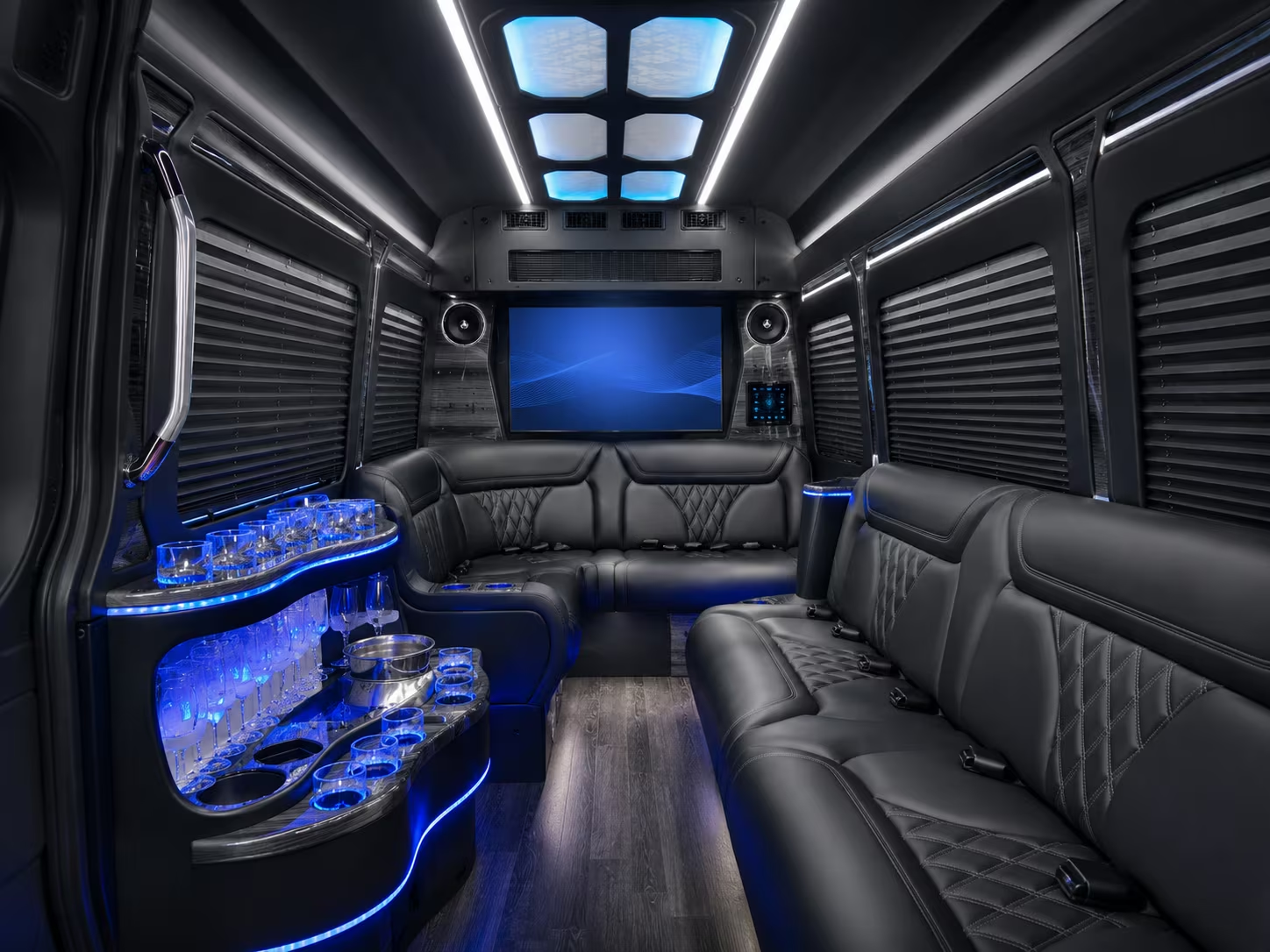
| Sprinter van / Sprinter limo | Up to ~14 | Interior cargo area, modest volume | Executive groups, small corporate teams, couples with standard bags |
| Party bus (15–50 passengers) | ~15–50 | Limited — lighter onboard storage | Celebration arrivals, bachelorette weekends, birthday groups with carry-ons |
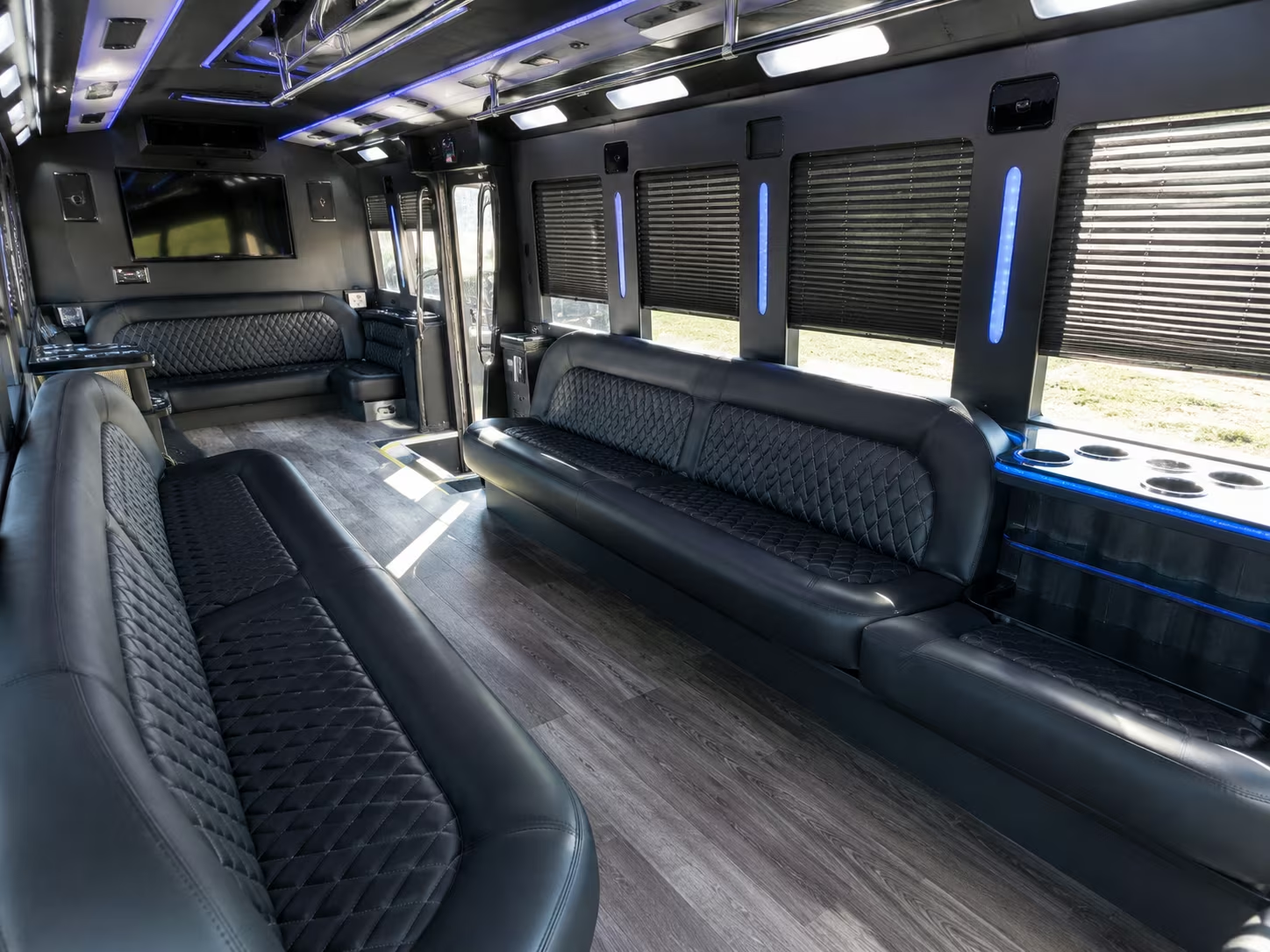
| 15–35 passenger minibus | ~15–35 | Overhead bins plus some underfloor | Mid-size ski groups with manageable gear, corporate teams, wedding party shuttles |
| 40–56 passenger charter bus | Up to 56 | Deep undercarriage bays — ski bags, equipment cases, full-size luggage | Large ski groups, sports teams, convention transfers, corporate retreats |
Ski and snowboard gear shifts the vehicle calculation more than almost any other luggage type. A 20-person group with two bags each and a ski bag apiece fills a minibus cleanly. A 40-person group with full boot bags and equipment cases almost always needs the deep undercarriage bays of a full-size charter bus — the overhead bins in a minibus are not built for that load.
Corporate groups with rolling bags and laptop cases fit comfortably in a minibus without that concern. When you call for a quote, giving your exact bag count alongside your headcount helps the network match you to the right vehicle on the first try.
SLC Airport Charter Bus Rental Prices
Airport transfer pricing at SLC moves with four factors: vehicle type, total trip time, pickup-to-drop-off distance, and your travel date. To give you a planning baseline — these are ranges from the network, not a quote or a guarantee, since real pricing moves with market conditions — here is how different vehicle types come in:
- Sprinter van: weekday $200–$275/hour, weekend $225–$375/hour; per-day $1,400–$2,750
- Minibus (15–35 passengers): weekday $200–$250/hour, weekend $200–$275/hour; per-day $1,100–$2,150
- Charter bus (40–56 passengers): weekday $200–$350/hour, weekend $200–$350/hour; per-day $1,350–$2,850
Split across a group, those numbers look different than they do as a lump sum. A 20-person group on a minibus at $200–$250/hour for a two-hour round-trip airport transfer might total $400–$500 for the whole bus — roughly $20–$25 per person. That same 20 people in five UberXL rides at $135–$210 each comes to $675–$1,050 before surge pricing.
On a powder-day Friday when surge hits 3–4x, the minibus is the obvious call. Your exact quote depends on your itinerary and dates — see the Salt Lake City party bus prices page for the full range, or call 385-230-6303 to get a number built around your specific headcount and schedule.
Peak Dates, Booking Windows, and How to Get a Quote
SLC's peak demand windows are not the same as most airports. The five dates when vehicle availability drops fastest and rideshare pricing hits its ceiling:
- Sundance Film Festival (late January, Park City): The Sundance window turns Park City into one of the most congested event destinations in the West for ten days — transportation to and from SLC fills up weeks ahead.
- Christmas–New Year's week: The single busiest airport week of the year, combined with peak ski season arrivals. Book as soon as your flights are confirmed.
- Martin Luther King Jr. weekend (January): A top ski weekend in the region — SLC sees a rush of arrivals on the Thursday and Friday before.
- Presidents Day weekend (February): Another peak ski window; demand for group airport transfers is at its highest of the season.
- Spring break (March–April): Families heading to the Wasatch resorts create another booking surge, particularly for minibuses and charter buses with gear capacity.
Outside those windows, two to three weeks of lead time is workable for most SLC airport runs. Inside those windows, book the moment your travel dates are confirmed — the right-size vehicles go first, and the per-person cost advantage over surge-priced alternatives disappears when you're waiting too long to book.
Getting a quote through Partybussaltlakecity.com takes under a minute. Use the online tool anytime, no account needed, or call 385-230-6303 and the support team can build a quote around your exact group size, pickup location, and dates on the spot. The Salt Lake City group transportation services page covers multi-stop itineraries and full-program packages if your airport run connects to a longer event schedule.
Tips for Groups Flying Into or Out of SLC
- One coordinator, one call. The B-Lane at SLC moves quickly — the airport's ground transportation office monitors commercial vehicle dwell times at the curb. Designate one person in your group as the bus contact. They call only when the full headcount is assembled at Level 1 with bags in hand, not while anyone is still at the carousel. One clean call beats three premature calls and a bus looping Terminal Drive.
- International arrivals exit at Level 1. If your group includes anyone on an international flight, they clear customs at ground level — separate from the domestic baggage claim flow on Level 2. The meeting plan should account for this split.
- Know your concourse before you land. Concourse A is primarily Delta; Concourse B handles Alaska, American, Frontier, JetBlue, Southwest, and United. Groups on split flights across both concourses can use the River Tunnel (opened October 2024, 1,175 feet) in the secure area to cross between concourses — but that only helps while still airside. The practical assembly point is Level 1 ground floor once everyone has cleared baggage claim.
- Build in canyon buffer time for departures. Parley's Canyon (I-80 East, route to Park City) and Little Cottonwood Canyon (route to Snowbird and Alta) both go to chain and AWD requirements during storms and occasionally close for avalanche control. A departure that feels comfortable on a clear morning can get tight fast when the canyon goes to controlled stop. Add 30–45 minutes of buffer any time a winter storm is in the forecast.
- SLC airport contact number: (801) 575-2400 — useful if anyone in your group gets separated, needs guest services, or has a question at the terminal once you're there.
Frequently Asked Questions
Where exactly does a charter bus drop off and pick up at Salt Lake City International Airport?
Charter buses use the ground level (Level 1) in the Bravo (B) Lane, between columns 3B and 5B. This is separate from the elevated Level 3 roadway where private passenger cars drop off departing passengers — a 13-foot height restriction at the terminal front is the reason full-size commercial vehicles use the designated ground-level commercial lane instead. For arriving passengers: descend from Level 2 baggage claim to Level 1 ground floor doors, then walk to the B-Lane.
For departing passengers: the bus pulls to the same B-Lane curb for loading before your group heads up to Level 3 for check-in. The official SLC ground transportation page covers the full layout.
What is the 13-foot height restriction at SLC, and does it affect my vehicle?
The 13-foot restriction applies to the terminal front curb area. Vehicles taller than 13 feet cannot use the elevated standard drop-off curb and are directed to the ground-level Bravo (B) Lane instead. Full-size charter buses are routinely directed to the B-Lane for this reason.
Sprinter vans and most minibuses typically clear 13 feet without issue — worth confirming at the time of booking if you're specifically on a taller vehicle type.
Where does the bus wait while my group collects luggage?
The bus stages in the free Park & Wait Lot — west of Terminal Drive, southeast of the terminal. The lot has electronic flight information signs displaying arrival status and "ready for pick up" notifications, so the wait is not blind. Amenities on-site include a Chevron gas station, convenience store, Burger King, and Costa Vida.
The protocol: bus stages in the lot, coordinator calls when the full group is assembled at the B-Lane with bags in hand, bus moves to the curb. The official pick-up/drop-off page outlines the approach.
What does parking cost at SLC airport?
Current rates per the official SLC parking page: Long-Term Economy is $14/day with complimentary shuttle; Lot E is $25/day; Daily Garage is $45/day; and Premium Reserved is $65/day. For a 10-car group parked in economy for a five-day ski trip, that is $700 in parking alone — before gas or canyon driving in winter conditions. A single bus rental split across the same 10-car group typically lands in a lower per-person range and skips the economy lot shuttle entirely.
Do commercial buses need permits or AVI tags to operate at SLC?
Yes. Per the airport's Ground Transportation FAQ, all commercial operators must carry a registered AVI tag or purchase a Pay-for-Use pass for the specific trip. Interstate operators register with the airport's Ground Transportation office and provide DOT MC Certificate documentation.
These are standard compliance requirements for any commercial ground transportation company operating at SLC. A properly registered operator in the network has this sorted before your trip begins — your group just shows up.
Can I use TRAX from the airport instead of renting a bus?
For solo travelers or small groups with carry-on bags and a downtown Salt Lake City destination: yes, TRAX is straightforward. Exit Door 1A on Level 1, walk east to the Green Line station, pay $2.50, and you're downtown in about 26 minutes. For groups with checked luggage, ski equipment, or more than four or five people: the practical limitations of loading gear onto a rail car make a private minibus or charter bus a much cleaner option.
TRAX schedules and route maps are at rideuta.com.
How far in advance should I book a bus for SLC airport?
For most SLC airport transfers outside peak windows, two to three weeks of lead time gets the job done. For Sundance Film Festival (late January), Christmas–New Year's, Martin Luther King Jr. weekend, and Presidents Day weekend, book the moment your travel dates are confirmed. Those windows fill quickly — the right-size vehicles go first, and booking early is the difference between getting the vehicle you want and taking whatever is left.
Call 385-230-6303 now to check availability for your date.
What is the drive time from SLC airport to Park City?
Park City is approximately 37 miles east via I-80 East through Parley's Canyon — about 35–45 minutes in dry conditions. In a winter storm, that same canyon corridor can push travel times to 60–90 minutes or more. For groups flying in for a Park City ski week, a single charter bus or minibus from SLC that loads all gear at once eliminates the coordination math around surge pricing and availability for multiple rideshares arriving on a winter Friday night.
Book Your SLC Airport Bus Today
Whether it's a 12-person ski group flying in Friday for a Wasatch powder week, a 40-person corporate team arriving for a Salt Lake City conference, or a wedding party that needs a clean airport-to-venue connection, the right vehicle for SLC starts with one quick quote. Partybussaltlakecity.com makes it easy to compare Salt Lake City airport charter buses, minibuses, Sprinter vans, and party buses from a large network of companies serving SLC — pricing available online in under 30 seconds, or any time over the phone at 385-230-6303. No account needed, no obligation, and a support team on hand to put together a custom package around your exact group size and schedule.
Your bus pulls to the B-Lane while the rideshare queue is still spinning surge fares. Call 385-230-6303 or use the online tool to get started.